Do I Need a Bigger Tankless Water Heater Gas Line?
Upgrading to a tankless water heater from a traditional tank system can require many additional home upgrades, from piping to electrical work. There are endless benefits to a tankless water heater system, such as its space-saving design and unlimited access to on-demand hot water. But this type of system also requires a much larger amount of gas in order to efficiently heat water on demand for your home. In this case, the size of your gas line absolutely must be taken into account.
Technical Factors That Determine Gas Line Sizing
Diameter alone doesn’t determine capacity. The longer the run from the meter to the appliance, the more pressure drops along the way. It is also not just your energy efficient water heater you need to take into account. Every other gas appliance matters too, like your furnace and dryer. Material counts as well: black iron pipe and corrugated stainless steel tubing (CSST) carry different volumes at the same nominal size.
BTU Capacity by Pipe Size: A Quick Reference
At standard residential pressure and a moderate run length, a three-quarter-inch line handles a meaningful share of a high-output unit’s demand, while a half-inch line falls short for most modern tankless models. Sizing tables also use “equivalent length,” which adds a penalty for every elbow, tee, and valve. A short run with many fittings can behave like a much longer straight pipe.
It’s also worth noting that tankless water heater electrical requirements factor into the overall installation picture. Most gas tankless units still need a dedicated electrical circuit — typically 120V — to power the ignition, controls, and venting fan. That’s a separate sizing consideration from the gas line, but one that should be confirmed early in the planning process so there are no surprises once installation begins.
The Risks of Undersizing: What Happens if You Oversize or Undersize a Gas Line?
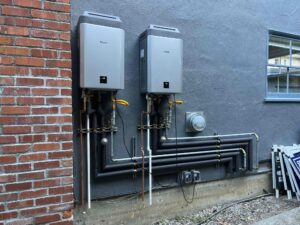
A gas line that’s too small will reduce the efficiency of your water heater. An inadequate amount of gas limits the heating ability of the water heater, leading to inconsistent temperatures and not enough hot water to meet your household’s needs. It can also cause hazards such as incomplete combustion, the chemical reaction that creates the heat source, that releases dangerous levels of carbon monoxide into the air. Excessive errors can also make the unit shutdown entirely.
At the same time, a gas line that is too big for your water heater can cause an unnecessary amount of fuel consumption that raises your energy bills significantly.
Either way, if your gas line is not sized just right, it reduces the efficiency of your system. Following tankless water heater power requirements is crucial to get the full benefits.
Common Symptoms of Incorrect Gas Line Sizing for Tankless Water Heater Systems
- Temperatures that swing hot to cold mid-shower, often described as the cold water sandwich
- Rumbling, vibrating, or harsh whooshing sounds during the ignition cycle
- Flame failure or low gas supply error codes on the display, a frequent trigger behind Rinnai water heater repair calls that turn out to be a fuel delivery issue, not a unit defect
Navigating the Hidden Costs of Tankless Upgrades
Some homes need a larger gas meter from the utility before a whole-home tankless install can be approved. Others can stay on their existing pipe by converting to a high-pressure two-psi system, a system that delivers gas from the meter at 2 pounds per square inch, with a regulator at the appliance. This pushes more volume through the same diameter.
Labor is the other variable. Running new pipe through a finished crawlspace, a slab-on-grade floor, or a low attic takes time, access work, and patching.
This is why an energy efficient water heater installation must first begin with an evaluation: if the existing supply comfortably serves a well-maintained tankless water heater, a full gas overhaul may not earn its keep. While you don’t always need to update a gas line for a tankless water heater, you need to be sure that your current gas line is able to handle the extra load without becoming inefficient.
Limitations and Considerations for Tankless Conversions
Not every home is a good tankless candidate. These units have more sensors, more controls, and more installation variables than a tank. Tankless water heater electrical requirements alone can be a large hurdle before installation even begins. Installed correctly on a properly sized line, these units are reliable. Installed on marginal fuel supply, they will not be efficient.
Climate also plays a role. Incoming ground water is colder in winter, so the unit must raise temperature further to hit the same setpoint, which raises BTU demand exactly when the furnace is also running.
These considerations are based on precise calculations. It calls for a measured load calculation, not a rule of thumb.
When Tankless Isn’t the Right Approach
- Long gas line relocations, slab work, or other tankless water heater power requirements that cost more than the unit will ever save in fuel
- Homes where the utility can’t practically upgrade meter capacity for the total load
- One- or two-person households, where a well-sized high-efficiency tank often delivers better return than a tankless water heater 50 gallon replacement project
How to Evaluate Your Current Tankless Water Heater Gas Line

When sizing your gas line for a tankless water heater, there are several guidelines you must follow to be up to code. Here are some steps to take to begin evaluating your current gas line and determine if it is acceptable to use with your new tankless water heater.
- When determining the gas line sizing for tankless water heater units, you want to start with your tankless model’s input rating. It will be different for every unit depending on what type of tankless water heater you are having installed. This will tell you the system’s peak fuel input rate, which is the maximum level of fuel that the unit can consume when operating at full capacity. The higher this rate is, the larger the gas line you need. However, it is not the sole decision of the exact pipe size your tankless unit will require.
- You need the BTU (British Thermal Unit) rating, which is the total amount of energy used per hour for the energy efficient water heater to heat water. This information should be available in the appliance manual. You then need to collect the BTUs of all other gas appliances in your home to calculate the total gas demand. These numbers can also be found on the appliance manuals or labels.
- Next, you will measure the distance of your pipe length, or how far it is from the gas meter to the water heater. Remember that the narrower the pipe is, the more restricted the gas flow will be, and any fittings, elbows, or tees along the way should be added to the length as well because of the restriction.
- The last thing to check is the gas pressure. The higher the natural gas pressure means the more gas can flow through the pipe and be delivered to your home.
Most whole-home units need three-quarter-inch or larger for a tankless water heater, confirmed by a load calculation that accounts for run length, fittings, and every other appliance on the system.
Key Takeaways: The Bottom Line on Gas Sizing
- Tankless units demand far more gas than tanks — roughly 150,000 to 199,000 BTU versus about 40,000 BTU for a typical storage heater.
- Existing half-inch lines are rarely adequate for a modern whole-home tankless installation.
- Distance from the meter and simultaneous appliance use drive sizing more than the energy efficient water heater rating alone.
- A repair-first assessment keeps you from buying upgrades the house doesn’t technically need.
- Most homes will require a ¾ inch or larger gas line size for a tankless water heater, though a thorough gas load calculation is highly recommended before deciding