Indoor vs Outdoor Tankless Water Heater Installation
Looking at your average Sonoma or Marin County home, there’s a good chance the old 50-gallon tank is already gone. North Bay homeowners have embraced on-demand hot water for practical reasons: recovered floor space, endless hot water, and real reductions in gas use. Tankless water heaters can be 24% to 34% more energy-efficient than conventional storage tank water heaters for homes that use 41 gallons or less of hot water daily.
But one real decision to consider when it comes to installing a tankless water heater is where the unit lives. That single choice drives venting design, gas line sizing, freeze risk, and how easy the system is to service a decade from now. Both installations have to respect the same safety fundamentals, including a minimum clearance from combustible materials of 12 inches, and both need gas service capable of feeding a high-BTU appliance.
When an Indoor Tankless Water Heater Makes Sense Than an Outdoor Tankless Water Heater Installation
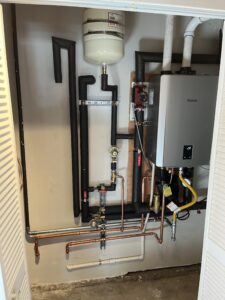
An indoor tankless water heater installation shelters the unit from everything that shortens equipment life outdoors: wind-driven rain, UV exposure, salt-laden fog off the coast, and the freeze-thaw swings that can hit in the winter. Electronics, sensors, and the heat exchanger all benefit from a stable, dry environment. The expected lifespan of a properly maintained tankless unit is 15–25 years, and indoor placement makes reaching the upper end of that range far more realistic.
Indoor installation also makes routine service easier. Descaling, the process of removing hard minerals from the unit, is one vital maintenance task that should be performed regularly. This is easier with an accessible unit. Filter cleaning, and sensor checks happen in a lit, dry space with an indoor unit rather than on a ladder in February rain.
Indoor placement is usually the stronger option when:
- The home already has a utility closet, laundry room, or garage wall with adequate combustion air and clearance.
- Gas service can be upsized without trenching across a finished yard or patio.
- The property sits in a cold inland pocket of Sonoma County where overnight lows regularly dip near freezing.
Venting is the trade-off. Indoor units require properly sized, code-compliant venting and verified gas line capacity, both of which belong in the design conversation before purchase, not after.
Outdoor Installation: Space Savings and Requirements
Can a tankless water heater be installed outside? Yes, and in the North Bay it’s often the best answer. Outdoor tankless water heater installation eliminates indoor venting entirely, since the unit exhausts directly to open air. That alone can recover a full utility closet in a compact home or free up the only usable wall in a garage. For houses with no attic access, no basement, and no spare interior wall, moving the tankless water heater outside is sometimes the only path available.
The convenience comes with strict placement rules. Outdoor tankless water heater installation requirements center on keeping exhaust away from anything that could ignite or draw combustion gases back indoors:
- Combustibles: Rinnai specifies a minimum clearance from combustible materials of 12 inches. Wood siding, fence boards, and trellises all count.
- Openings: The unit must sit a specified distance from operable windows, doors, and vents so exhaust can’t re-enter the house.
- Air intakes: Mechanical intakes, dryer vents, and HVAC louvers need separation to prevent recirculation.
Outdoor units are not maintenance-free. Exposure to weather means more frequent inspection, not less.
Critical Infrastructure: Gas Capacity and Condensate
The two issues that most often derail a tankless project are hidden in the gas piping and the drainage. This is true whether it is a tankless water heater attic installation, outdoor installation, or basement installation.
Gas capacity. A tankless unit fires at a far higher input rate than the storage tank it replaces, because it heats water instantly rather than slowly maintaining a tank full of water. If the existing gas line, meter, or branch piping was sized for a modest tank plus a furnace and range, the new unit can be starved during peak demand, meaning it will produce lukewarm water, error codes, and short cycling that stresses components. A proper load calculation covers every gas appliance in the home, the total developed length of the run, and the pipe diameter at each segment. In many North Bay homes that means upsizing a section of pipe, and in some cases coordinating a meter upgrade with the utility.
Condensate management. High-efficiency condensing models extract so much heat from the exhaust that water vapor condenses inside the unit. That condensate is acidic and shouldn’t drain untreated into cast iron, galvanized, or older drain assemblies. A neutralizer kit, a cartridge of media the condensate passes through, raises the pH before discharge, protecting both the home’s plumbing and the municipal system. Neutralizer media is consumable and needs periodic replacement.
Regional Considerations: Freezing and Microclimates
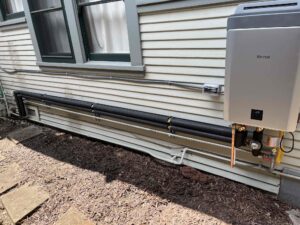
In Sonoma and Marin County, it is not uncommon to have frost buildup on clear winter nights, and those overnight lows are precisely what threaten an outdoor tankless unit and make an indoor tankless water heater installation more attractive.
Most outdoor models include internal freeze protection, but it only works while the unit has power. A winter outage removes that protection exactly when it’s needed. Exposed water lines, isolation valves, and condensate drains on the exterior wall are also vulnerable because they sit outside the heater’s own protection.
Pro Tip: For outdoor installations in colder inland pockets, pair the unit with insulated line covers and heat trace tape on exposed supply, return, and drain lines. Confirm the circuit feeding the heater isn’t on a switched outlet, and know how to drain the unit before an extended winter absence.
Coastal homes face a different stressor. Salt-laden fog accelerates corrosion on cabinets, fasteners, and exterior piping, so units within a few miles of the water need more frequent visual inspection than inland equipment.
A tankless water heater attic installation solves the space problem but introduces leak risk above finished ceilings. It demands a properly sized drain pan, a routed pan drain, and ideally a leak sensor.
The Bottom Line of Choosing Your System
For most North Bay homes, indoor placement wins on durability and serviceability, while outdoor placement wins on space. The right answer depends on what your house physically allows and which microclimate it sits in. Use these points as a decision framework:
- Indoor units are the gold standard for longevity. Protected from rain, fog, salt air, and freeze cycles, an indoor unit faces fewer environmental stressors across its service life and is easier to descale and inspect on schedule.
- Outdoor units are the best problem-solvers for tight layouts. When a home has no attic, no basement, and no interior wall with adequate combustion air and clearance, can a tankless water heater be installed outside? Exterior mounting makes an outdoor tankless installation possible, provided clearances to windows, air intakes, and combustibles are respected.
- Verify gas and venting capacity before you buy. Confirm the gas line, meter, and venting path can support the unit’s input rating. Discovering a shortfall mid-installation turns a one-day job into a multi-visit project.
- Professional installation protects both warranty and safety. Manufacturer warranties generally require code-compliant installation, and combustion venting is not a DIY category.
Expert Installation and Maintenance in the North Bay
Tankless placement decisions depend on local venting and clearance requirements, how a specific neighborhood’s gas service is sized, and whether a given wall faces coastal fog or inland frost. Eichler homes add another layer of complexity. Their open-plan construction, flat roofs, and in-slab radiant heating mean a water heater is often tied into more than domestic hot water. Replacing or relocating equipment in these homes requires understanding how the hydronic side works before anything is disconnected.
That’s the kind of specialized servicing John Owens Services Inc. has built its reputation on across the North Bay. We have been experts in residential water heaters since 1986, always keeping up on modern, energy-efficient technology and best practices when it comes to installation. We are knowledgeable in all indoor and outdoor tankless water heater installation requirements and can help you decide on the most feasible option for your home. When you are unsure about what placement is best for your tankless water heater, we are the factory-trained experts who can help.
Schedule a site assessment with John Owens Services Inc. to get a placement recommendation based on your home’s actual gas capacity, venting options, and microclimate.